

It’s not every day that a conversation about co-op housing involves a murder mystery. But this is exactly what happened during my interview with Merrilee Robson. And it makes perfect sense. Her novel, Murder Is Uncooperative, is more than just a cozy mystery. It reflects the joys, challenges, and resilience that define co-op living, written by a founding member of B.C.’s co-operative housing movement.
Life in Trafalgar Co-op
Merrilee’s co-op journey began in 1979, when residents transformed a struggling 20-unit rental building along a tree-lined street in Vancouver’s Kitsilano neighbourhood into Trafalgar Housing Co-operative. At the time, the idea seemed unlikely. Merrilee recalls that, “Nobody in this building has any money.” But with support from VanCity Credit Union and CMHC’s Section 95 program, this unlikely idea became a lasting reality.
It wasn’t easy. Knocking on doors, organizing meetings, persuading neighbours, and building consensus required persistence. Moreover, the building needed significant renovations. But working together, the nascent co-op members transformed unseemly units into family-friendly homes in a quickly gentrifying neighbourhood. In the process, Merrilee realized that she and her neighbours were doing more than saving their homes; they were building a community.

Growing a Movement
Trafalgar’s transformation marked the beginning of Merrilee’s involvement with co-op housing. By the early 1980s, she saw that the new housing co-ops forming across BC were isolated and lacked a collective voice. After helping organize the 1981 CHF Canada annual general meeting in Vancouver, Merrilee and others were inspired to establish the Co-operative Housing Federation of British Columbia (CHF BC).
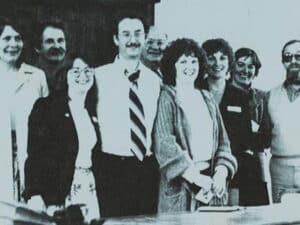
April 24, 1982 CHF BC’s founding board members signed the paperwork for our incorporation which was finalized on July 27, 1982. Original board members (left to right): Diane Smythe, Pioneer; Jack Allen, Adanac; Merrilee Robson, Trafalgar; Herb Barbolet (president), Community Alternatives; Wes Bray, Brooksford Place; Margaret Montgomery, Alder Bay; Sharon Scott, Klahanie; Judy Parkin, False Creek; and Vicke Bassewitz, Mission.
The new federation supported B.C.’s housing co-ops in sharing knowledge, developing leadership, and advocating for supportive government policies. Merrilee soon became president of CHF BC. In this position, she helped establish COHO Management Services Society, a sector-owned property management company that understood co-op governance and values. Together, CHF BC and COHO worked to strengthen the sector and foster connections that empowered co-ops to advocate for themselves.
Safeguarding the Sector
Merrilee was also active in advocating for co-ops at the national level. One of her most powerful memories was the campaign to prevent the transfer of housing co-op programs to the provinces. With a stridently conservative government in Ontario and a potential change in government in B.C., Merrilee and others worried that this devolution of oversight and fragmentation of programs could weaken—or even dismantle—the co-op housing sector.
Once again facing unlikely odds, Merrilee worked with co-op housing advocates across the country in a massive grassroots campaign to halt the transfer. Through numerous local meetings, coordinated lobbying efforts, and widespread mobilization, the campaign was successful, resulting in the creation of the Agency for Co-operative Housing to protect federal co-operative housing programs. For Merrilee, this proved that when federation members unite, they can beat overwhelming odds and influence decisions at the highest levels of government.

A Mystery Novel with a Deeper Lesson
Years later, Merrilee combined her love of writing with her co-op experience to write Murder Is Uncooperative. She jokes that co-ops are “the perfect mystery trove”—small, close-knit communities where secrets and tensions naturally arise.
For those of us living in housing co-ops, the book offers a deeper lesson, examining housing insecurity, affordability, and the often-complicated realities of living closely. Merrilee admits that co-ops aren’t perfect; conflicts happen, and not every decision is easy. However, her novel shows how cooperative values such as fairness, collaboration, and education enable members to resolve challenges constructively. And thankfully, Merrilee laughs, “most co-op disputes don’t end in murder.”
A Lasting Legacy
The moral of Merrilee’s co-op story is clear. Whether through community building, grassroots advocacy, or creative writing, housing co-operatives demonstrate how people can live differently—together.
What started as a desperate bid to save her home became a community legacy, preserving housing affordability for generations. Decades after its founding, Trafalgar is thriving. Children play in its yard, neighbours tend its gardens, and families continue to call it home. These everyday details reveal that housing co-ops are more than just a place to live—they are lifelong communities.
Merrilee’s story also demonstrates how ordinary people coming together with a shared purpose can achieve extraordinary things. Her leadership helped lay the foundation for the co-op housing movement in BC. This foundation continues to shape communities across the province today.